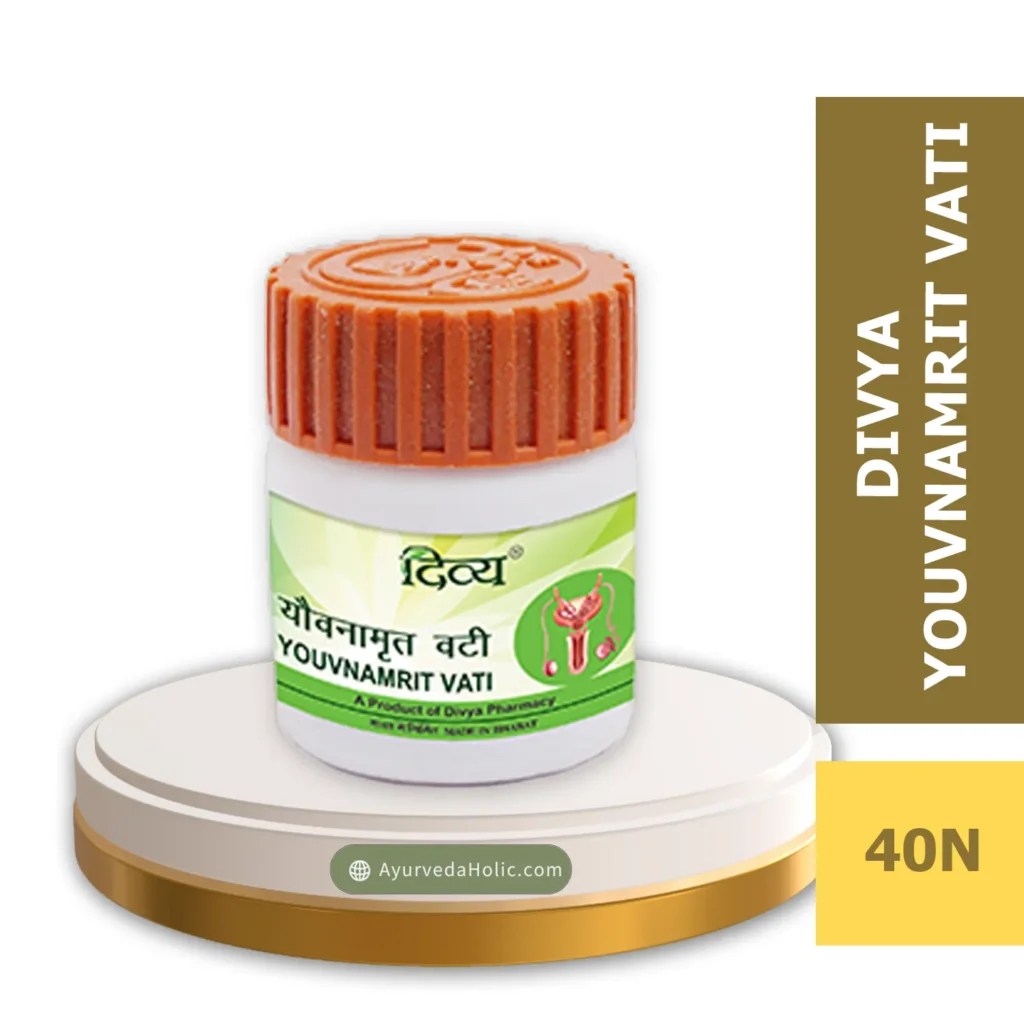
People often compare Patanjali Youvnamrit Vati vs Ashwagandha when they want to choose an Ayurvedic product for their daily wellness routine. Both options contain Ashwagandha, but they are not the same type of formulation.

Patanjali Youvnamrit Vati combines several Ayurvedic herbs and traditional preparations. Patanjali Ashwagandha, on the other hand, focuses on Ashwagandha as its key ingredient. The right choice depends on what you are looking for and whether a qualified professional recommends the product for you.
In this guide, we compare their ingredients, formulation, traditional uses, dosage information, and important precautions.
What Is Patanjali Youvnamrit Vati?
Patanjali Youvnamrit Vati is a multi-ingredient Ayurvedic tablet manufactured by Divya Pharmacy.
The current Patanjali product page lists Ashwagandha, Shuddha Konch, Satavar, Safed Musli, Javitri, Jaiphal, Shuddh Kuchla, Akarkara, Swarn Bhasma, Praval Pishti, Vang Bhasma, Shuddh Shilajit, and Pan Ras among its key ingredients.
The manufacturer recommends taking 1–2 tablets twice daily with water or milk, or as directed by a physician. It also states that users should take the product under medical supervision.
Because the formulation contains several ingredients, Youvnamrit Vati differs significantly from a single-herb Ashwagandha product.
What Is Patanjali Ashwagandha?
Patanjali Ashwagandha is a more focused formulation. The current Patanjali product page lists Ashwagandha (Withania somnifera) as its key ingredient. The product comes in capsule form.
Patanjali currently recommends 1–2 capsules twice daily or as directed by a physician for its Ashwagandha capsules.
So, the biggest difference starts with the formulation itself:
- Youvnamrit Vati: Multi-ingredient Ayurvedic tablet
- Patanjali Ashwagandha: Ashwagandha-focused capsule
Patanjali Youvnamrit Vati vs Ashwagandha: Key Differences
| Feature | Patanjali Youvnamrit Vati | Patanjali Ashwagandha |
|---|---|---|
| Form | Tablet | Capsule |
| Main focus | Multi-ingredient Ayurvedic formula | Ashwagandha |
| Ashwagandha | Included | Main ingredient |
| Other herbs | Several | Not the main focus |
| Traditional preparations | Includes bhasma and pishti preparations | Not listed in the same multi-ingredient formula |
| General dosage | 1–2 tablets twice daily, as directed | 1–2 capsules twice daily, as directed |
| Professional guidance | Manufacturer advises medical supervision | Follow physician/product directions |
The current manufacturer information supports these formulation and dosage differences.
Which One Contains More Ingredients?
Patanjali Youvnamrit Vati contains more ingredients.
Its formula combines several herbs with traditional Ayurvedic preparations.
The listed herbs include:
- Ashwagandha
- Shuddha Konch
- Satavar
- Safed Musli
- Javitri
- Jaiphal
- Shuddh Kuchla
- Akarkara
It also includes:
- Swarn Bhasma
- Praval Pishti
- Vang Bhasma
- Shuddh Shilajit
- Pan Ras
Patanjali Ashwagandha has a much simpler ingredient profile because the current product listing identifies Ashwagandha as its key ingredient.
Which One Has Ashwagandha?
Both products contain Ashwagandha.
However, the role of Ashwagandha differs.
Patanjali Ashwagandha focuses on Ashwagandha as the primary ingredient. Youvnamrit Vati combines Ashwagandha with several other ingredients.
Therefore, someone looking specifically for an Ashwagandha-focused product may prefer a simpler formulation, while someone seeking a broader Ayurvedic formulation may consider Youvnamrit Vati.
Patanjali Youvnamrit Vati Benefits vs Ashwagandha Benefits
It is important to avoid treating these products as interchangeable.
Traditional Perspective of Youvnamrit Vati
Youvnamrit Vati combines several ingredients traditionally associated with vitality, nourishment, and rejuvenation-oriented Ayurvedic practices.
The formulation includes herbs such as Ashwagandha, Shatavari, Safed Musli, Konch, and Shilajit.
Because the formula contains multiple ingredients, its traditional profile differs from that of a single-herb Ashwagandha product.
Traditional Perspective of Ashwagandha
Ashwagandha has a long history in Ayurveda.
Traditional Ayurvedic practices use the herb in various formulations associated with general nourishment and vitality.
A dedicated Ashwagandha product gives consumers a simpler way to focus on this particular herb.
Neither option automatically suits everyone. Individual needs and circumstances matter.
Which Is Better: Youvnamrit Vati or Ashwagandha?
There is no universal answer.
The better option depends on your reason for considering an Ayurvedic product.
Choose a Simpler Formulation
If you specifically want an Ashwagandha-focused product, Patanjali Ashwagandha provides a more straightforward ingredient profile.
You can clearly identify Ashwagandha as the key ingredient.
Consider a Multi-Ingredient Formulation
If you are looking for a broader Ayurvedic formulation, Youvnamrit Vati contains several herbs and traditional preparations.
However, its more complex ingredient profile also makes professional guidance more important. Patanjali specifically advises medical supervision for Youvnamrit Vati.
Youvnamrit Vati vs Ashwagandha for Daily Wellness
People often use the phrase “daily wellness” when searching for Ayurvedic supplements.
However, you should not select a product simply because it contains more ingredients.
A multi-ingredient formula does not automatically provide greater benefits than a single-herb product.
Instead, compare:
- Your reason for using the product
- Complete ingredient list
- Recommended dosage
- Existing medicines
- Allergies or sensitivities
- Product instructions
- Professional advice
This approach helps you make a more informed choice.
Youvnamrit Vati vs Ashwagandha Dosage
The two products have different dosage instructions.
Youvnamrit Vati
Patanjali currently recommends 1–2 tablets twice daily with water or milk, or as directed by a physician. The manufacturer also advises medical supervision.
Patanjali Ashwagandha
Patanjali currently recommends 1–2 capsules twice daily or as directed by a physician.
Do not use the dosage from one product for the other.
Always check the current packaging before taking either product.
Can You Take Youvnamrit Vati and Ashwagandha Together?
Do not assume that you should combine them simply because they have different formulations.
Both products contain Ashwagandha. Taking them together could increase your overall intake of the same herb.
Youvnamrit Vati also contains several additional ingredients.
If you already use Ashwagandha and want to add Youvnamrit Vati, speak with a qualified Ayurvedic practitioner or healthcare professional first.
Which One Is Easier to Understand?
From an ingredient perspective, Patanjali Ashwagandha has the simpler formula.
You can identify Ashwagandha as its key ingredient.
Youvnamrit Vati has a much broader formula. Its ingredient list includes herbs, Shilajit, and traditional bhasma and pishti preparations.
Therefore, consumers who prefer simpler formulations may find Ashwagandha easier to evaluate.
Which One Requires More Caution?
Youvnamrit Vati deserves careful attention because its formulation contains several ingredients, including Shuddh Kuchla and traditional bhasma and pishti preparations.
The manufacturer specifically states that users should take Youvnamrit Vati under medical supervision.
Patanjali Ashwagandha also requires responsible use. Follow its product directions and consult a professional if you take medicines, manage a health condition, or have other concerns.
What About Side Effects?
Every person can respond differently to herbal products.
You should not assume that a natural or Ayurvedic product will suit everyone.
Before using either product:
- Read the current ingredient list.
- Check the recommended dosage.
- Consider your existing medicines.
- Consider known allergies or sensitivities.
- Ask a healthcare professional if you have concerns.
Stop using a product and seek appropriate medical advice if you experience an unusual or concerning reaction.
Can Women Take These Products?
Do not assume that every Ayurvedic formulation suits everyone.
Pregnant or breastfeeding women should consult a qualified healthcare professional before using either product.
Children should also use such products only when a qualified professional recommends them.
Your individual circumstances matter more than a general comparison between two products.
Youvnamrit Vati vs Ashwagandha: Which One Should You Buy?
Your decision should start with the formulation rather than the product name.
Patanjali Ashwagandha may appeal to you if:
- You specifically want an Ashwagandha-focused product.
- You prefer a simpler ingredient profile.
- You want Ashwagandha in capsule form.
- A healthcare professional considers it suitable for you.
Patanjali Youvnamrit Vati may appeal to you if:
- You are interested in a multi-ingredient Ayurvedic formulation.
- You want a formula that combines several traditional ingredients.
- A qualified professional recommends the formulation for your needs.
- You understand its more complex ingredient profile.
The manufacturer recommends medical supervision for Youvnamrit Vati, so follow that guidance.
Where to Buy Patanjali Youvnamrit Vati Online?
If you decide to purchase Patanjali Youvnamrit Vati online, you can check Ayurveda Holic for current product availability and details.
Before placing your order, check the product name, pack size, price, expiry date, packaging, and seller information.
Always read the product label when the package arrives.
Frequently Asked Questions
Is Patanjali Youvnamrit Vati the same as Ashwagandha?
No. Both products contain Ashwagandha, but Youvnamrit Vati combines it with several other Ayurvedic ingredients. Patanjali Ashwagandha focuses on Ashwagandha as its key ingredient.
Which is better, Youvnamrit Vati or Ashwagandha?
Neither product is universally better. Your choice should depend on your individual needs, the ingredient profile, and professional advice.
Does Youvnamrit Vati contain Ashwagandha?
Yes. Ashwagandha appears among the key ingredients listed by Patanjali.
Can I take Ashwagandha with Youvnamrit Vati?
Both products contain Ashwagandha, so do not combine them without professional guidance.
Is Youvnamrit Vati a single-herb product?
No. Youvnamrit Vati contains several herbs and traditional Ayurvedic preparations.
Is Patanjali Ashwagandha a simpler formulation?
Yes. The current Patanjali listing identifies Ashwagandha as its key ingredient.
Which product has more ingredients?
Patanjali Youvnamrit Vati has a significantly broader ingredient profile than the Patanjali Ashwagandha capsules.
Can I take Youvnamrit Vati every day?
Follow the current product directions and your physician’s advice. Patanjali recommends medical supervision for Youvnamrit Vati.
Final Thoughts
The comparison between Patanjali Youvnamrit Vati vs Ashwagandha comes down to their different formulations.
Patanjali Ashwagandha provides a simpler, Ashwagandha-focused option. Youvnamrit Vati combines Ashwagandha with several other Ayurvedic herbs and traditional preparations.
Neither product automatically suits everyone. Your individual needs, existing medicines, allergies, and health circumstances should guide your decision.
If you are unsure which option fits your routine, consult a qualified Ayurvedic practitioner or healthcare professional. Always follow the latest product label and recommended dosage.
For Youvnamrit Vati in particular, follow the manufacturer’s advice to use the product under medical supervision.